
$BANK: Poker Staking Meets Venture Dilution

@bankmefun launches $BANK March 4 at 15:00 UTC via @metaplex Spotlight on Solana, with the sale window running through March 6. The token is issued by FANtium AG (Zug, Switzerland) within the FANstrike ecosystem and positions itself as an on-chain poker capital markets platform. Strategic backers include Davidi Kitai (three-time WSOP bracelet winner, ~$11.7M career live earnings), Daniel Rezaei (~$10.9M career live earnings), and Dominic Thiem. Venture backers include Vyking Ventures and FunFair Ventures.
The concept is interesting. The execution choices raise serious questions. Public buyers are getting fund-level risk with venture-level dilution, and the product that could justify that structure is not the one launching on day one.
Two Businesses, Two Return Profiles
$BANK‘s roadmap describes two fundamentally different businesses, and the expected investor economics for each look nothing alike.
The Fund
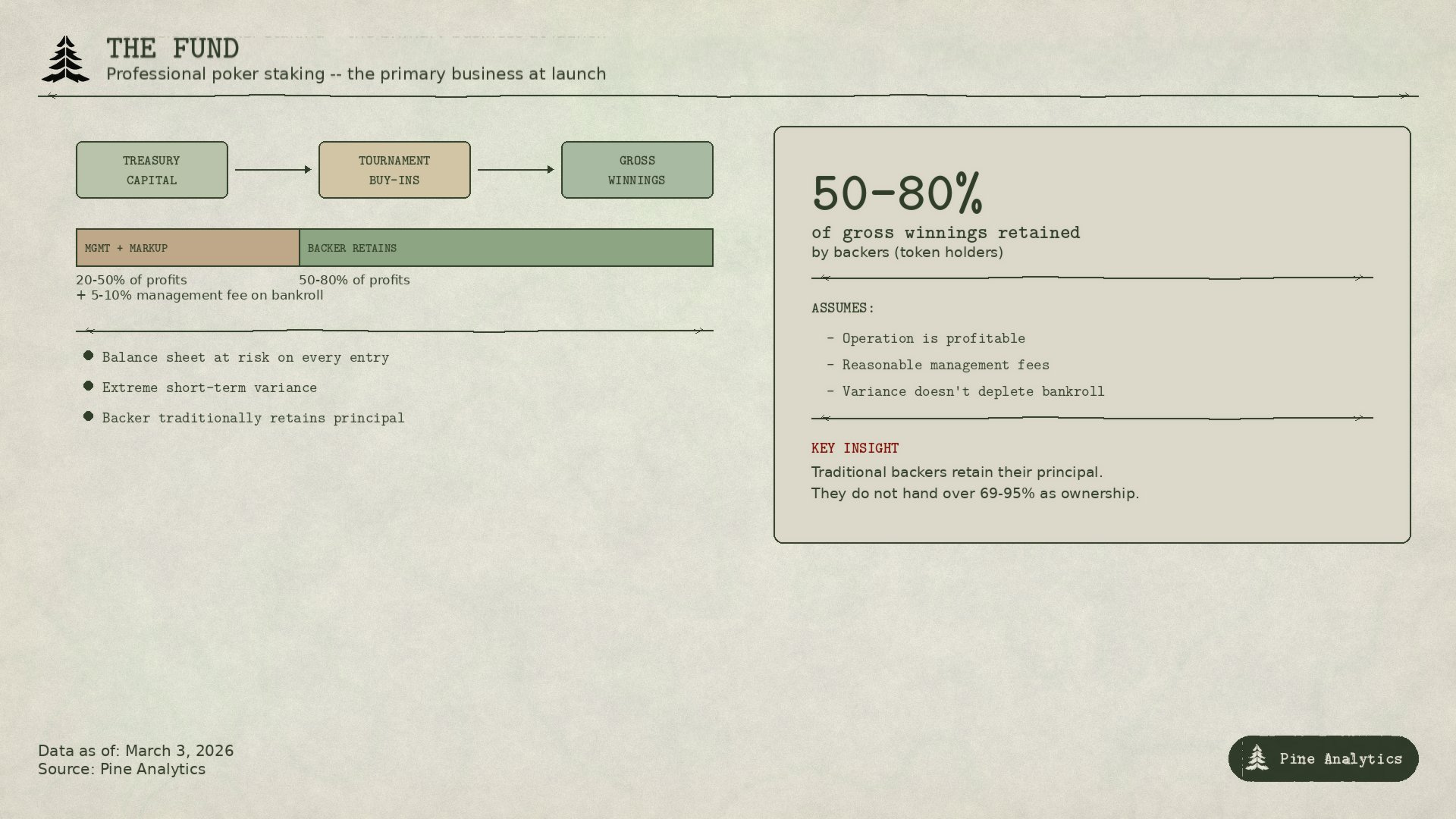
The primary business at launch is a professional poker staking operation. Treasury capital raised from the token sale is deployed into high-stakes tournament buy-ins. Profits flow back to the treasury and a portion funds token buybacks.
The economics here are well-understood. Professional poker staking operations typically charge a management fee of 5-10% of the bankroll plus 20-50% of net profits as a performance allocation (often called “markup” in poker staking). After accounting for these fees, the backer -- in this case, $BANK token holders via the treasury -- might expect to retain somewhere between 50-80% of gross operating winnings. That is a meaningful haircut, and it assumes the operation is profitable in the first place. This is a capital-intensive, variance-heavy model where the protocol’s own balance sheet is at risk on every tournament entry.
Critically, in a traditional staking arrangement, the backer retains ownership of their principal. The staker takes a cut of profits. The backer does not hand over 69-95% of their capital as an ownership stake to the fund manager.
The Platform
The secondary business on the roadmap is a platform where individual poker players launch their own staking tokens through FANstrike, with $BANK as the base asset. Fans buy these tokens to back specific players, and the platform collects middleware fees on issuance and trading. Poker-specific prediction markets are also planned.
This is a fundamentally different type of investment. A fee-generating middleware platform at the seed stage would typically offer investors 10-20% equity ownership in exchange for a raise in the low single-digit millions. The investor is not buying a cut of operating profits from day one -- they are buying ownership in a business whose value compounds as adoption grows. Launchpad fees, prediction market rake, and transaction fees all scale without requiring the protocol to deploy its own capital at risk.
The platform business is genuinely interesting. If FANstrike gains meaningful traction, the platform economics dwarf the fund economics because the upside is tied to enterprise value growth rather than a percentage split on poker winnings. This is the business that could justify a token structure. It is not the one launching on March 4th.
The Dilution Problem
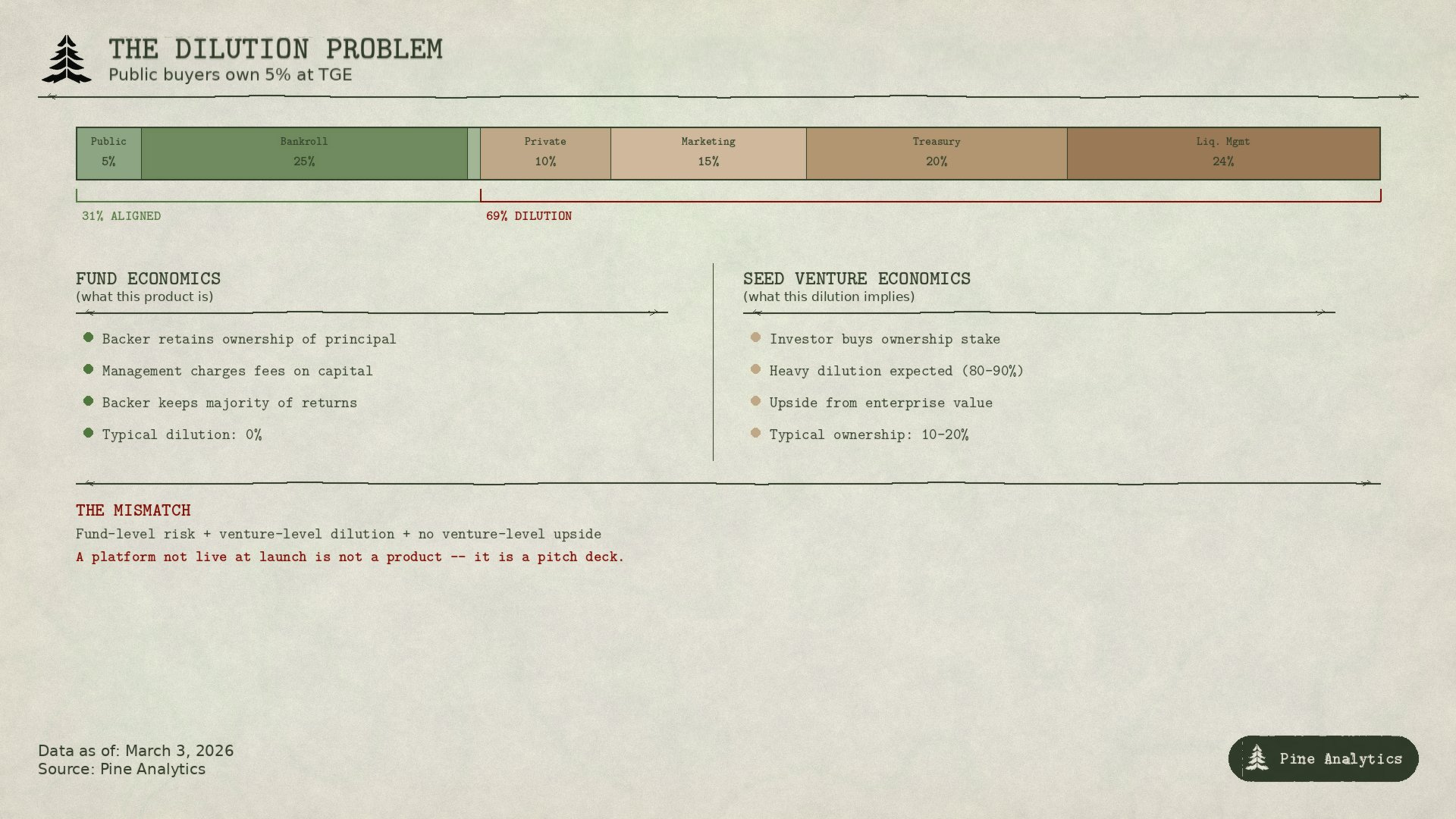
At TGE, 50,000,000 tokens (5% of the fixed 1B supply) are distributed to public buyers, fully unlocked. The remaining 95% is allocated as follows: poker bankroll (25%), liquidity management (24%), treasury (20%), marketing (15%), private sale (10%), and Raydium pool (1%).
The poker bankroll and Raydium pool allocations are described as holder-governed, so you could argue they serve public interest. Under that charitable reading: public sale (5%) + bankroll (25%) + Raydium (1%) = 31% aligned with holders, leaving 69% dilution from treasury, liquidity management, marketing, and private sale allocations. Under a less charitable reading where only the public sale tokens represent true buyer ownership, the dilution is 95%.
Either number creates a structural problem. A traditional staking fund does not retain 69-95% ownership of the capital pool. It charges management and performance fees on deployed capital while the backers retain ownership of their principal and the majority of returns. The dilution profile here is not consistent with fund economics. It is consistent with seed-stage venture economics, where 10-20% ownership in exchange for early capital is standard and expected -- because the investor is buying exposure to compounding enterprise value, not a share of tournament winnings.
$BANK‘s public buyers get the worst of both worlds: fund-level risk (capital deployed into poker tournaments, subject to variance and management fees) with venture-level dilution (5% ownership at best, 5% of a fund with no compounding equity story at worst). The team might respond that the bankroll generates returns that accrue to all holders through buybacks, or that the platform is in active development. But buybacks funded by poker winnings after a 20-50% performance fee on a 25% bankroll allocation do not math their way into justifying 69%+ dilution. And a platform that is not live at launch is not a product -- it is a pitch deck.
The Team Problem
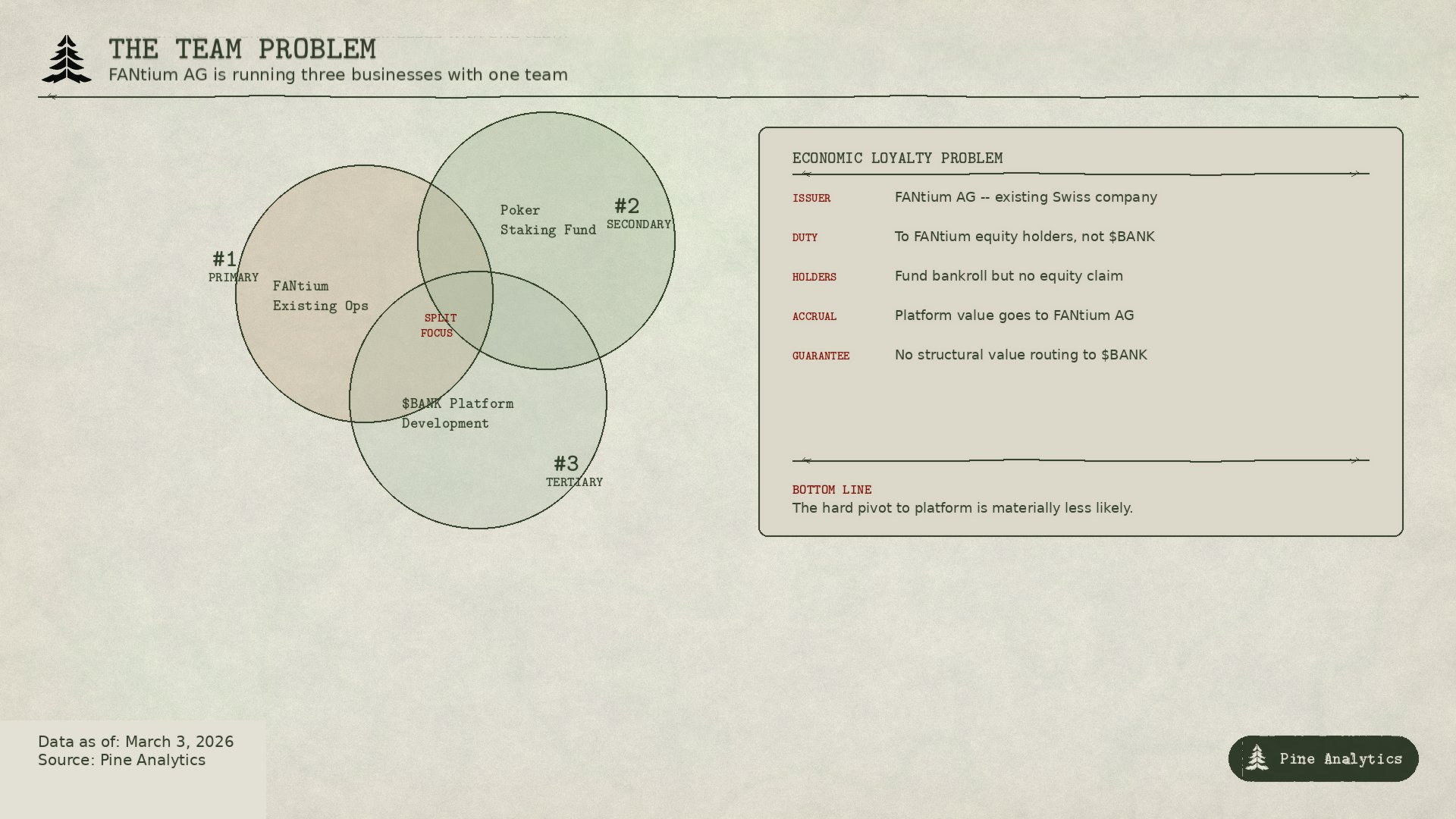
The team behind $BANK is not a dedicated startup building FANstrike from scratch. It is FANtium AG -- an existing company with its own product, obligations, and operational overhead. $BANK is a token being layered on top of a business that already exists and already demands the team’s attention.
This matters because the bull case for $BANK depends entirely on the team pivoting hard into platform development. But the team is now splitting focus three ways: running FANtium’s existing operations, managing a poker staking fund with active tournament deployments and player relationships, and supposedly building out a new platform. The platform is already the secondary priority behind the fund in $BANK‘s own messaging. In practice, it is arguably tertiary behind FANtium’s core business.
It also raises the question of where economic loyalty sits. FANtium AG is the issuing entity. The team’s fiduciary incentives are to FANtium’s equity holders and its existing operations, not to $BANK token holders. Token holders are funding a bankroll that the team operates, but they have no equity claim on FANtium itself or on the platform revenue if it ever ships. If FANstrike becomes a successful fee-generating platform, the value accrues to FANtium AG as the operating entity. $BANK holders are along for the ride only to the extent the team chooses to route value back through the token -- and there is no structural guarantee that they will.
The bandwidth required to run an existing company, manage active poker bankroll deployments, and build a new platform from scratch makes the “hard pivot to platform” scenario -- the only scenario where the token works -- materially less likely.
What to Watch
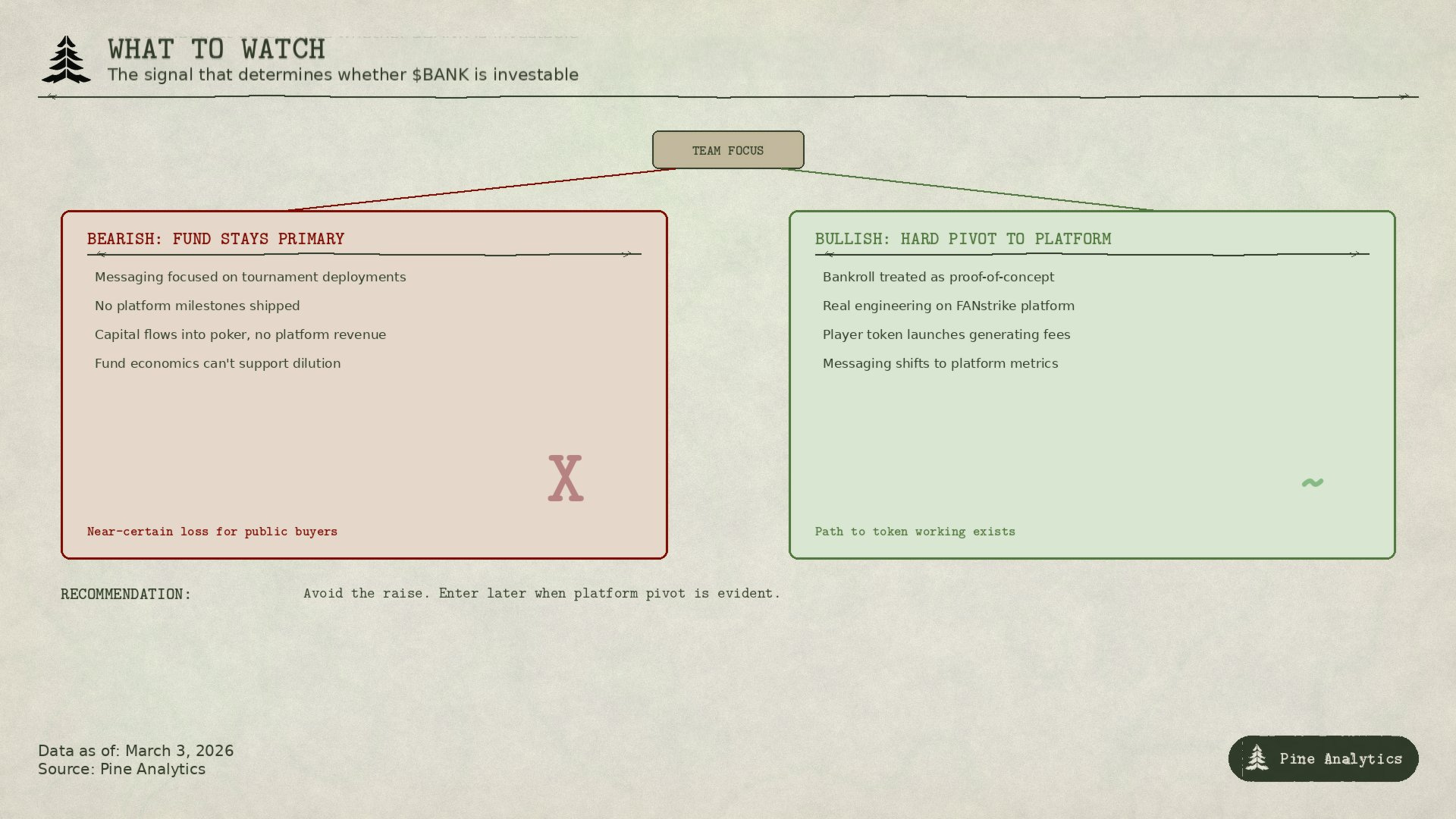
All of the public messaging from the team centers on deploying capital into poker tournaments and reinvesting winnings. If this remains the primary focus, it is near-certain that initial investors get washed. The fund economics simply do not support the dilution structure, and every dollar of team attention spent running a staking fund instead of building the FANstrike platform and delivering value to $BANK holders is squandering the one asset that could make the token worth holding.
The signal to watch for is a hard pivot. If the team treats the bankroll as a proof-of-concept sideshow and puts its real energy into building, shipping, and scaling the player staking platform, there is a path to the token working. A smart investor should avoid the raise.