
$WET is 15x Overvalued


Starting in June of 2025, @humidifi launched on Solana and rose from no market share of the Solana spot DEX volume to making up just under half of all DEX spot volume on chain by early December. The Humidifi token launched at the start of December at a $50M or $69M valuation depending on the buyer cohort, raising the team $5.57M. Immediately after launch the token surged to a $300M valuation within two days. The price of the token sat in the $200M to $300M FDV range before a continuous downtrend to its current FDV of $76M.
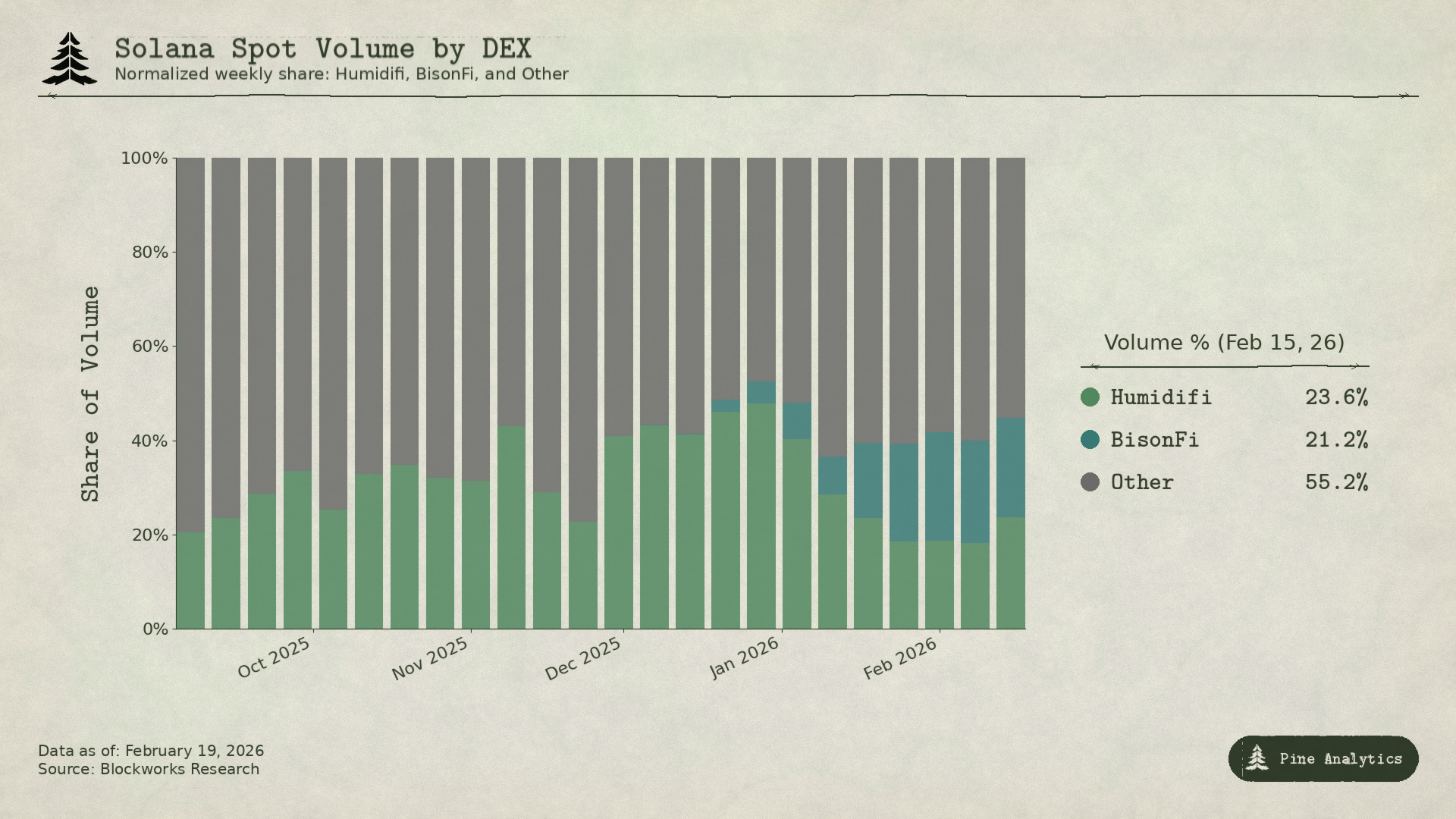
When looking at the volume of Humidifi, it reached its peak market share 4 weeks after the token launch at 47% of the DEX market share on Solana. Since then, the market share of Humidifi has fallen to about 23%, roughly half of what it was 7 weeks ago. This decline in market share was largely driven by a decline in Humidifi volume on its SOL-stablecoin pairs along with a rapid increase in volume on Bisionfi's SOL-stablecoin pairs. Other smaller contributing factors to this market share loss have been growth in volume on AlphaQ, Manifest, and Aquifer.
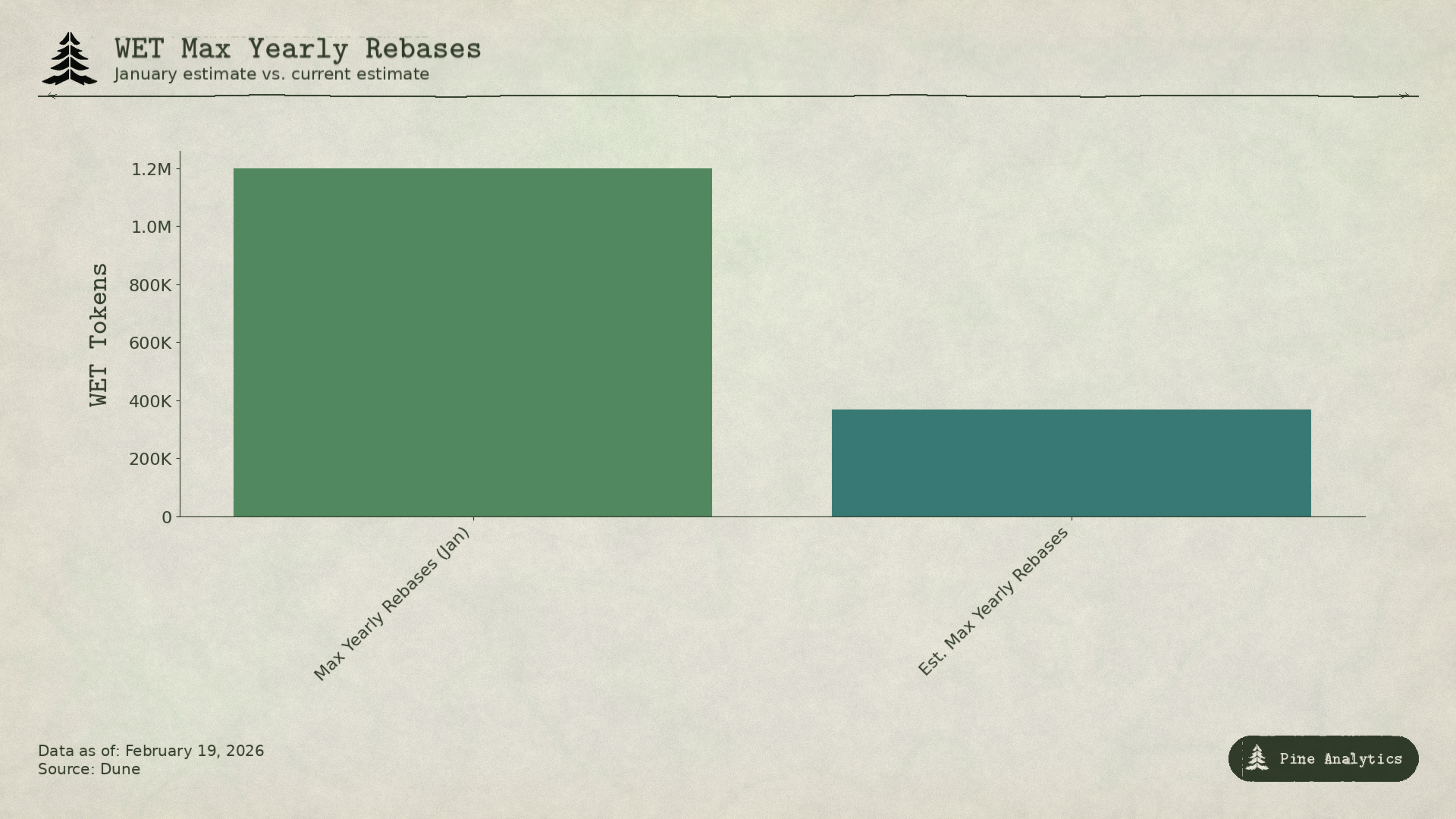
The main use case of the $WET token is staking rebates for token stakers, so to evaluate this token we want to break down the total size of potential rebates and how desirable they are in practice. Based on this @Blockworks research article, as of the start of the year when Humidifi was doing $1.3B in volume a day, they were earning net profits from their trading activity of about $14K a day. The max staking fee rebate is 25%, so if 100% of the volume was being rebated from WET tokens staked, that would lead to a total of $1.2M for token stakers. Currently the daily volume of Humidifi is sitting around $370M, so if the relationship between volume and team profit is linear, they are currently earning about $4K a day in profits, leading to about $363K in max possible rebates going to stakers if all volume came from wallets with max staked positions.
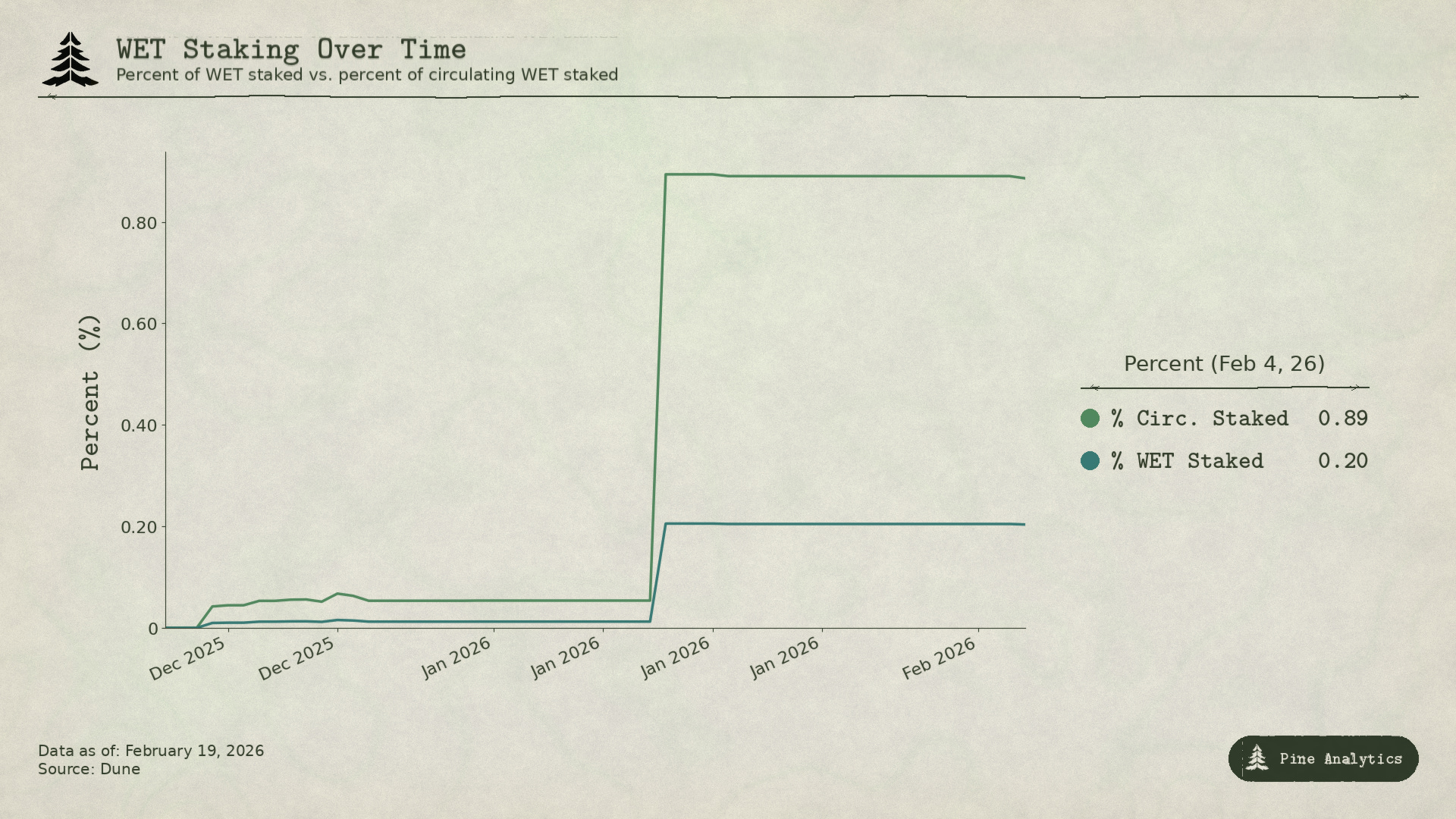
In practice, the staking of the WET token is almost nonexistent. For the first month of the WET token being live, zero wallets staked enough WET to receive even the lowest fee rebate, which is 10% off of the platform fees. On January 12th, a wallet staked 1.93M WET tokens, which would qualify the wallet for 15% trading rebates if the tokens were staked for over 190 days and 10% rebates if the tokens were staked for over 20 days. Digging into this wallet, you would suspect it to be driving a lot of volume on chain to capture this rebate, but when you look into the wallet you notice that the WET staking event is the last event this wallet has made, and it has not executed a single trade since. This wallet was just funded by Binance, bought the WET, staked the tokens, and did nothing else.
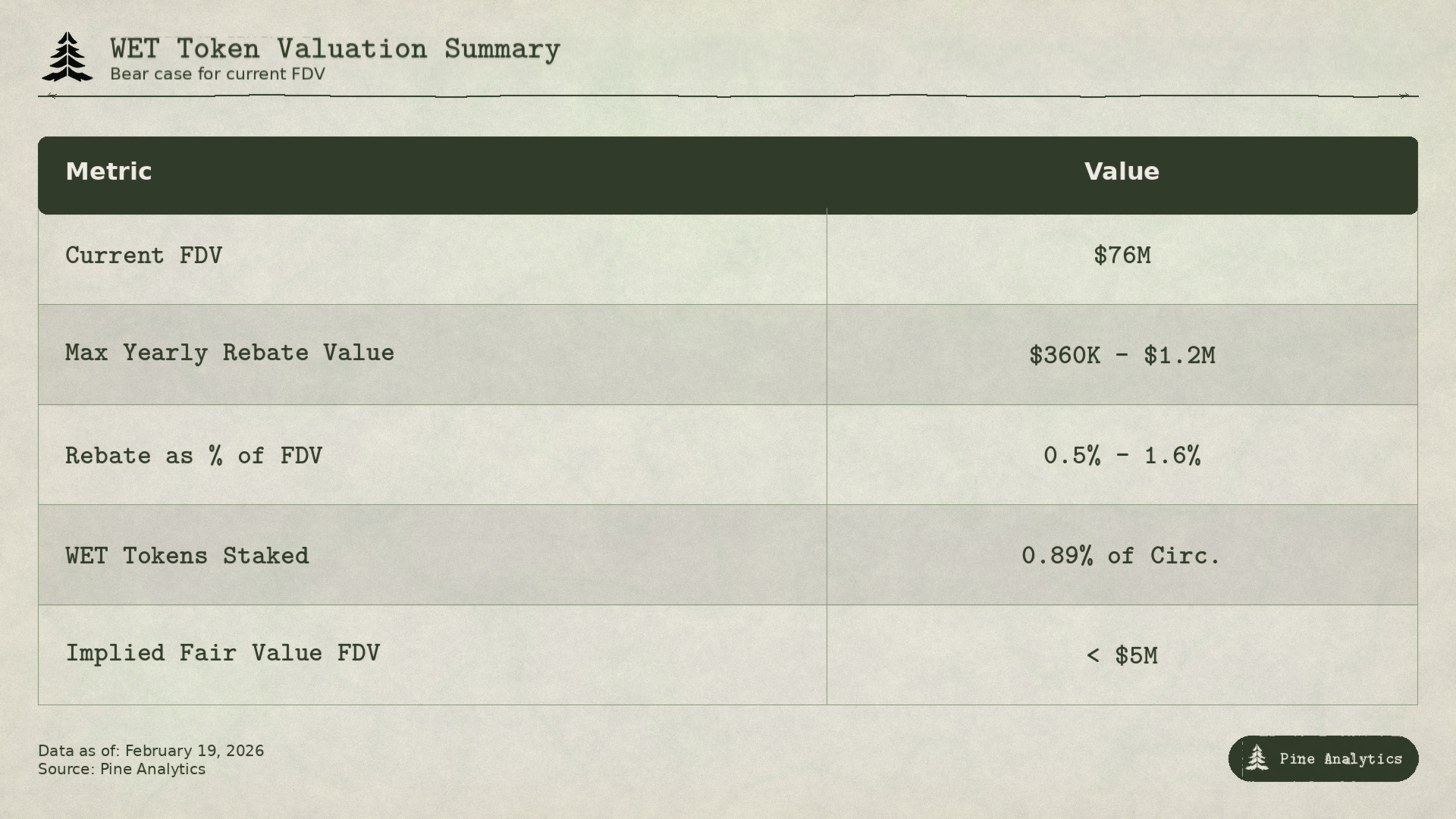
Looking at Humidifi and the WET token holistically, the picture is one of a DEX that rose to dominance, launched a token, and has seen declining activity ever since. This is happening in a market where highly competent competitors are coming online to take share and moats are effectively nonexistent. WET trades at a $76M FDV where the maximum yearly benefit to token holders amounts to just 1/63rd to 1/211th of the token's value. Not a single holder has found it worthwhile to claim this benefit, likely because the exposure to holding WET carries risk that far outweighs any rebate upside. Based on its current utility alone, it is difficult to justify a valuation above $5M FDV. The team has teased additional utility through Aquarium, but even if that tripled what the token should be worth, it would still imply 80%+ downside from here.