
What is Bedrock? The Ownership Gap, and Why It Matters


Bedrock just went live with its first launchpad partners. A joint venture between Meteora and GVRN AI (a Singapore-based legal technology firm), Bedrock is a permissionless legal framework that incorporates a BVI entity for token projects and places an independent foundation on the cap table with enforceable shareholder rights. It launched with three integrated launchpads: Bags, star.fun, and Collateralize, with more planned.
To understand why Bedrock exists and what problem it is trying to solve, you need to look at what happened in crypto M&A over the past year.
The Problem: 2025’s Acquisition Cycle Exposed Token Holders
Crypto had a record M&A cycle in 2025. Coinbase made nine acquisitions. Pump.fun went on a buying spree. Kraken’s Ink Foundation absorbed an entire protocol. Q3 alone saw 96 transactions totaling over $10 billion, the largest quarter on record. The deals got bigger, faster, and more aggressive.
But through all of it, one group kept getting left behind: token holders.
When a traditional company gets acquired, shareholders receive compensation. The acquirer buys the company, and the shares are the company, so shareholders get bought out. In crypto, that relationship between token and entity has never existed. Tokens sit adjacent to the company. They are not the company. And when the music stops, adjacency pays nothing.
Pantera Capital named this dynamic explicitly in their January 2026 outlook, citing multiple cases where “token-based ecosystems were acquired or restructured without direct compensation to token holders.” They noted this was a key driver behind digital asset equities outperforming tokens in 2025, as investors sought clearer paths to value capture.
Vertex Protocol and Kraken’s Ink Foundation (July 2025)
In July 2025, the Ink Foundation (backed by Kraken) acquired Vertex Protocol’s core technology stack: order book, perpetual futures engine, lending code, and the entire engineering team. The deal was structured to rebuild the DEX exclusively on Ink’s Layer 2 network.
The VRTX token was sunsetted entirely. Holders received an airdrop of just 1% of the future INK token supply, determined by a snapshot taken on July 8. All treasury and non-vested VRTX was burned. At the time of the announcement, VRTX had already fallen roughly 98% from its November 2023 debut, with its market cap collapsing from $77 million to under $4 million. The token dropped an additional 41% on announcement day.
The Ink Foundation absorbed the technology. The Vertex team moved to Ink. Holders were compensated with a sliver of a token that did not yet exist.
Pump.fun and Padre (October 2025)
Pump.fun acquired Padre, a multichain trading terminal with approximately 5% of Solana’s trading bot market share, on October 24. The announcement stated that the PADRE token would “no longer have utility on the platform with no further plans for the future.” The token crashed over 80% within hours.
Initially, no compensation was offered. The community reaction was severe, with widespread accusations of a rug pull. Pump.fun eventually offered a PUMP token airdrop equivalent to the value of PADRE held at a pre-announcement snapshot, claimable by December 30.
As Blockworks noted, this was a goodwill gesture, not a legal obligation. If Pump.fun acquired Padre for $40 million and the PADRE token’s snapshot value was around $5 million, then compensating holders at market was roughly 13% of what they would have received as equity holders in a traditional acquisition. Shareholders would have gotten the full deal value pro rata. Token holders got whatever crumbs the acquirer chose to offer.
Coinbase and Vector.fun (November 2025)
Coinbase’s ninth acquisition of the year was Vector.fun, a Solana-native DEX aggregator built by Tensor Labs. Vector’s technology was folded into Coinbase’s trading infrastructure. The Vector apps were shut down.
The Tensor NFT marketplace and TNSR governance token were carved out and transferred to the independent Tensor Foundation. TNSR holders received no direct compensation from the acquisition. The Foundation burned 21.6% of supply (unvested founder and Labs tokens) and relocked remaining founder allocations for three more years. Marketplace fee revenue was redirected fully to the TNSR treasury.
TNSR saw dramatic price action around the deal. The token surged over 500% in the week prior to announcement, with trading volume spiking from sub-$10 million daily levels to $1.9 billion on November 20, one day before the public announcement. It then dumped 37% on announcement day. The pattern raised significant questions about front-running.
Dragonfly investor Omar Kanji summarized the broader frustration at the time: “TNSR token holders just had their best asset stripped and got ~$0 in return. If this continues, people will just stop buying tokens.”
How Bedrock Works
Bedrock’s answer to this problem is to layer traditional corporate law onto the token launch process. It does not try to make tokens into equity. Instead, it places a legally structured third party on the cap table of the project company, with rights that activate precisely when a founder tries to extract value through equity channels while leaving token holders behind.
The Launch Flow
The process runs in parallel with a normal token launch on any Bedrock-integrated launchpad:
The founder creates a token through the launchpad.
The founder submits KYC in parallel.
The target raise amount is achieved and the token graduates.
If KYC clears, a BVI company is incorporated under the Bedrock framework.
Upon successful incorporation and documentation, the project is Bedrock-compliant.
The legal infrastructure only activates upon successful incorporation. It is decoupled from the token launch itself. Holding tokens from a Bedrock project confers zero equity rights. The token remains a token. The protection comes from the Foundation’s position as a shareholder in the company.
Equity Allocation
The founder determines how much preference equity Bedrock holds, within set bounds. The minimum is 10% preference shares plus a golden share. The maximum is 30% preference shares plus a golden share. The founder retains at least 70% in ordinary shares and maintains full operational control.
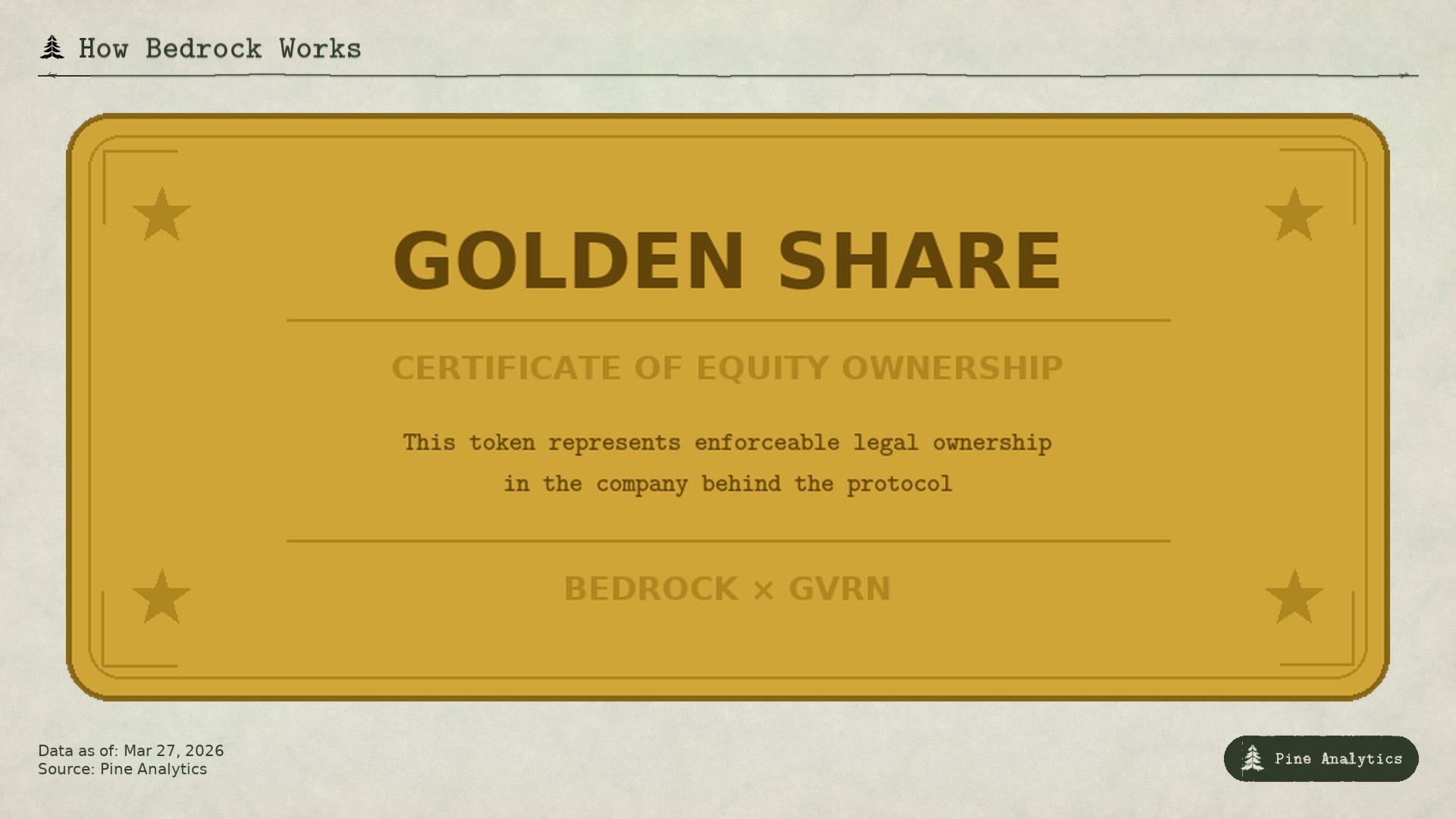
The golden share is the key structural element. It gives the Foundation protective rights that outweigh ordinary shares in specific enforcement scenarios, while leaving the founder free to run the business day to day.
The Takeover Mechanism
This is where Bedrock directly addresses the M&A problem.
The Foundation’s preference equity can be acquired by any party that holds 100% of the project’s total token supply. This is structured as a standing invitation to treat (an expression of willingness to negotiate, not a binding commitment to sell). The counterparty must be an accredited investor and pass KYC/AML/CTF checks.
Since accumulating 100% of a token’s supply on the open market is practically impossible, Bedrock includes a constitutional buyout mechanism modeled on public company mandatory bid codes. Any party that can demonstrate ownership of 30% or more of the total token supply can trigger a mandatory buyout of the remaining tokens.
The buyout price formula is:
(100% - % of tokens surrendered) x Token Total Supply x (7-day TWAP x 1.30)
The 30% premium over the trailing 7-day time-weighted average price is embedded in the company’s constitutional documents. This means if someone wants to acquire the project, they must pay a premium to consolidate both the token supply and the Foundation’s equity position.
For founders, this also creates an exit valve. If the token trades at very low levels, the founder can acquire the supply cheaply and buy back the equity at market prices, effectively unwinding the Bedrock structure.
Enforcement
The Foundation maintains an enforcement fund of up to $2 million. Enforcement activates in cases of founder fraud or bad faith, unauthorized value extraction (acquisition, asset sale, or related-party transaction without engaging the Foundation’s rights), or post-incorporation discovery of criminal conduct.
Enforcement does not activate for project failure, operational disagreements, or token price decline. Bedrock protects against bad actors, not against bad outcomes.
What Founders Get
Beyond the protective structure, Bedrock provides a fully incorporated company with shareholder agreements, proper IP attribution, and ownership set up as part of the launch process. Without it, founders typically spend weeks arranging this themselves, or skip it entirely, creating legal exposure down the line.
How Bedrock Compares to Other Ownership Coin Models
Bedrock is not the only framework on Solana attempting to bridge the token-equity gap. Two other notable approaches are MetaDAO’s futarchy-based ICO model and SOAR’s DRP standard. Each takes a fundamentally different approach.
MetaDAO: Market-Governed Organizations
MetaDAO, backed by Paradigm, implements futarchy: a governance system where prediction markets evaluate proposals rather than token-weighted votes. Anyone can propose an action, and participants trade PASS and FAIL tokens to bet on whether it will increase the organization’s token price. If PASS outperforms by at least 3%, the proposal executes automatically.
MetaDAO expanded from governance into capital formation. Projects launching via MetaDAO use futarchy to control the treasury and mint authority of tokens, meaning the market governs financial decisions rather than a founding team or traditional board. The DAO LLC owns core IP, there is no separate labs entity that can siphon off revenue, and spending requires ongoing market approval.
MetaDAO has facilitated over $33 million in cumulative raises across 11 launches. Protocols like Drift, Jito, and Sanctum have adopted its tools. The model works well for crypto-native organizations that embrace full on-chain governance, but it demands a level of market sophistication and active participation that may not suit every founder or project type.
SOAR: The DRP Standard
SOAR uses its Digital Representation of Participation standard (patent pending). When a company launches on SOAR, only about 5-6% of token supply enters initial circulation. The company signs a senior debt agreement where the debt percentage equals the percentage of tokens in circulation. If 10% of tokens are circulating, the company owes SOAR 10% of its value upon a liquidity event. Minting more tokens increases the debt. Buying back decreases it.
After a 3-month lockup, founders can mint additional tokens but must publicly disclose the amount and purpose 72 hours in advance. There is no governance vote or veto. The check on behavior is transparency and the market’s ability to sell.
As we noted in our January analysis, the model has interesting properties but faces open questions. The contracts between SOAR and launching teams are not currently public, and the platform’s trading volume has settled into five-figure daily levels after an initial burst.
The Key Differences
Where protection comes from: MetaDAO uses prediction markets and DAO ownership of IP. SOAR uses senior debt tied to token circulation. Bedrock uses preference equity and a golden share under corporate law.
Founder freedom: Bedrock gives the most operational freedom, with rights activating only in bad-faith or acquisition scenarios. SOAR creates a soft check via the transparency window. MetaDAO creates the most ongoing friction through continuous market evaluation.
Holder participation required: Bedrock requires none; the Foundation acts on holders’ behalf. SOAR requires monitoring 72-hour minting disclosures. MetaDAO requires active prediction market trading.
M&A specifically: Bedrock is the only framework explicitly designed around acquisition scenarios, with a constitutional buyout mechanism and premium baked into governing documents. MetaDAO makes value extraction difficult by design through DAO IP ownership. SOAR’s debt mechanism creates a financial claim during liquidity events, but enforceability depends on contract terms that are not publicly auditable.